
Complaints and Appeals

At IMC, your wellbeing is our top priority. We are here to support you, and we encourage open communication to help resolve any concerns you may have.
If you’re experiencing difficulties with your grades or any aspect of student life, we are committed to ensuring that your concerns are heard and addressed promptly, confidentially, and with genuine care. Our aim is to support you with a positive resolution that strengthens both your academic progress and your overall well‑being.
IMC values every member of our community, and we’re here to guide and support you every step of the way.
The below information and flowchart in accordance with Student Complaints and Appeals Policy and the Student Complaints and Appeal Procedure can help you understand the process.
What's difference between informal complaints and formal complaints?
An Informal Complaint is a grievance issue that a student may raise informally directly with the person(s) involved or directly to the Senior Student Services Manager.
A Formal Complaint is a grievance issue that a student seeks to resolve by lodging a formal complaint with the Student Grievance Committee.
Example:
| Action | Content |
|---|---|
| Information/Feedback | A student notifies that the air conditioning is malfunctioning. |
| Student Request | A student reports that the air conditioning is set too cold or too hot and requests a temperature adjustment. |
| An informal complaint | An issue with the temperature of the air conditioning might become an informal complaint if the student identifies that they have previously asked for an adjustment/rectification of the air conditioning temperature and are not satisfied with the outcome (the temperature adjustment provided or the explanation of why a temperature adjustment is not feasible). |
| A formal complaint | A student lodges a formal complaint about the air conditioning by filling out the formal complaint form. |
What is an appeal?
An appeal is a formal complaint made by a student to the Student Grievance Committee to reach an outcome regarding their studies and/or student-life in relation to either a non-academic matter or for a reconsidered academic grade.
If I have an informal complaint, what can I do?
You can discuss the complaint with the person/s concerned directly, or you can approach the Senior Student Services Manager for assistance. IMC will discuss the best outcome and agree to act together to resolve the complaint.
If my informal complaint is not solved, what can I do?
You can lodge a formal complaint.
Can I ask for advice before making a complaint or appeal?
Yes. You may contact the Senior Student Services Manager for confidential guidance before deciding what action to take.
Student Services can help you:
- understand the difference between an informal concern, formal complaint and appeal;
- identify the relevant policy and process;
- understand what information or supporting documents may be required;
- consider the available internal support services; and
- identify the appropriate submission pathway.
Seeking advice does not require you to proceed with a formal complaint or appeal.
What information should I include?
To help IMC understand and respond to the matter, you should provide clear and concise information where possible, including:
- your name, student number and contact details;
- a short description of what happened;
- when and where it happened;
- the people or areas involved;
- the steps you have already taken to resolve the matter;
- any response you have already received;
- how the matter has affected your studies, wellbeing or student experience;
- the outcome or resolution you are seeking; and
- relevant supporting information, such as emails, letters, photographs, records or other documents.
You do not need to use legal or technical language. If you are unsure what to include, Student Services can provide guidance.
A requested outcome must still be considered in accordance with IMC policy, the available evidence and the authority of the relevant decision-maker.
Accessible information and reasonable adjustments
IMC is committed to providing an accessible and inclusive complaints and appeals process.
You may ask for a reasonable adjustment or alternative method of communication if disability, illness, injury, language, technology or another accessibility barrier affects your ability to access or participate in the process.
Depending on your circumstances, assistance may include:
- receiving information in an accessible or alternative format;
- assistance to understand or complete a form;
- making a complaint or appeal through an alternative communication method;
- additional time or breaks during a meeting;
- use of assistive technology;
- having an appropriate support person attend a meeting; or
- another reasonable adjustment identified through consultation with you.
Please contact Student Services if you require assistance or experience an accessibility barrier. IMC will discuss your needs with you and consider reasonable adjustments while maintaining fairness and academic integrity.
Will my information remain confidential?
IMC will treat information relating to complaints and appeals sensitively and will share it only where reasonably necessary to:
- provide support;
- assess or respond to the matter;
- obtain relevant information;
- ensure procedural fairness;
- make an authorised decision; or
- meet legal, regulatory or safety responsibilities.
Confidentiality does not always mean that all information can remain between you and the first person you speak with. A person who is the subject of a complaint may need to understand and respond to the substance of the concern.
Where possible and appropriate, IMC will explain:
- why information needs to be shared;
- who may receive it;
- what information may be provided; and
- what may happen next.
IMC will limit disclosure to information that is reasonably necessary for the relevant purpose.
Will I be treated differently for raising a concern?
You should not be treated adversely because you have raised a concern, sought support, made a complaint or participated in a complaints or appeals process.
IMC does not tolerate victimisation, retaliation, intimidation, harassment or adverse treatment associated with raising a concern or complaint.
If you believe that you have experienced retaliation or are concerned about possible retaliation, contact the Senior Student Services Manager as soon as possible.
What if I do not want to provide my name?
You may raise information anonymously. Anonymous concerns will not be automatically dismissed and may help IMC identify safety risks, recurring behaviour, service problems or broader patterns. To lodge anonymous concern, please click here.
However, anonymity may limit IMC’s ability to:
- clarify the details;
- obtain supporting information;
- provide an individual remedy;
- ensure procedural fairness;
- conduct a full investigation; or
- advise you of the outcome.
Student Services can explain how your information may be handled and help you consider whether you feel comfortable providing additional information.
IMC cannot guarantee that a person will remain unidentifiable where the details of the matter reveal their identity or where there is a serious safety, legal or institutional obligation to act.
How can I lodge a formal complaint/appeal?
The flowchart below outlines the entire Complaints and Appeals process.
Please note that:
- You can lodge your complaint by completing the Complaint Form and emailing it to [email protected] or [email protected] within 20 working days of the complaint arising.
- The Senior Student Services Manager will support you by providing advice and assisting you with preparing your complaint or appeal during this period.
- You may withdraw your complaint at any time in writing. When all possible internal resolutions have been utilised, you may seek an external resolution. When an external resolution begins, all internal processes will cease.
What will happen during the period of SGC investigation?
- IMC’s Student Grievance Committee (SGC) is responsible for investigating and acting upon all formal student grievances.
- The grievance investigation may involve speaking to relevant staff or students, accessing the student file and/or speaking to external parties. The student will be advised should the SGC consider it necessary to involve external parties in the investigation and confidentiality will always be respected. External parties can include the Institute’s agents or related parties if the complaint is in regard to a student’s experience with these parties.
What if I am not satisfied with the outcome of a formal complaint or appeal?
You can go to external bodies to appeal this decision.
- International students may appeal their outcome to the National Student Ombudsman:1300 362 072 or https://www.ombudsman.gov.au/complaints/international-student-complaints
- Domestic Students may appeal their outcome to the Resolution Institute: [email protected] or www.resolution.institute.
Students will also be provided with advice regarding avenues of appeal. The written response should be provided within five (5) working days of the decision being made and any implementation required following the decision.
The Student Complaints and Appeals Process
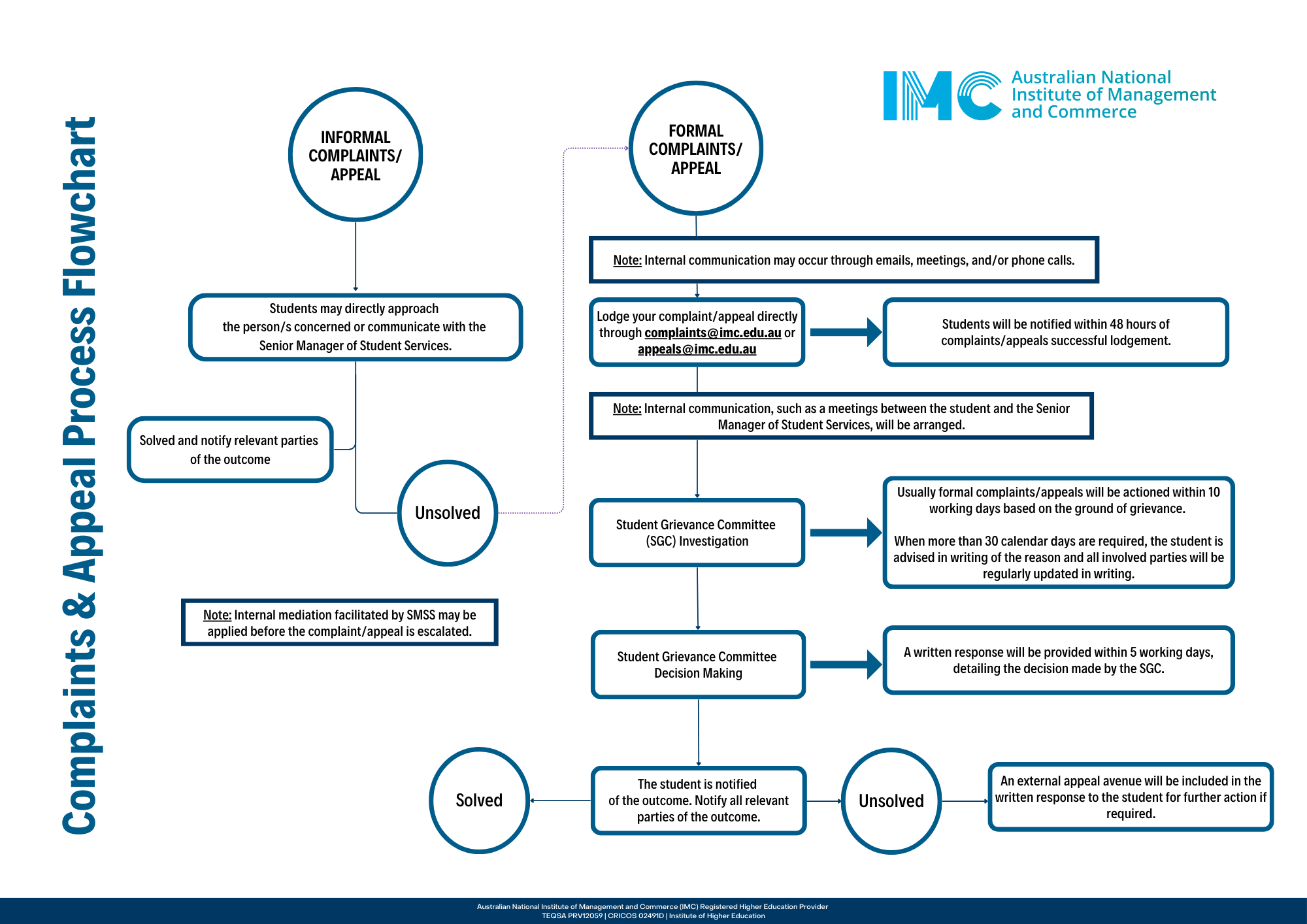
Download the Complaint Process Bifold Brochure for further details regarding raising your concerns.
You may lodge a concern anonymously using the Anonymous Online Form. Please note that anonymity may limit IMC’s ability to investigate the matter fully, seek clarification or provide you with an individual outcome.
